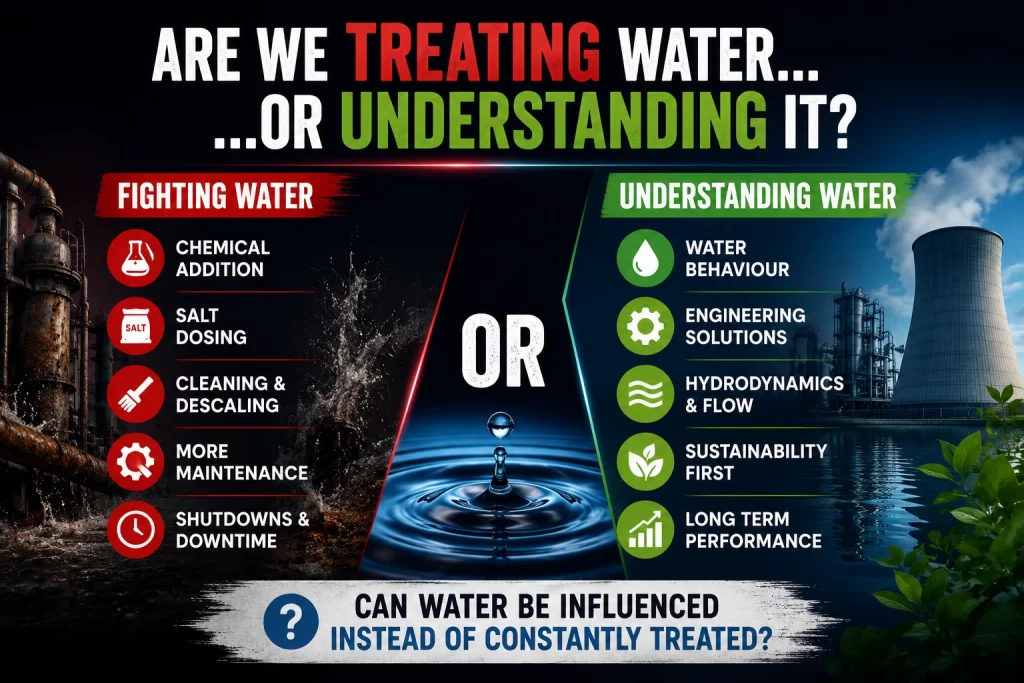
For decades, the industrial response to water challenges has often been:
- Add more chemicals
- Increase dosing
- Clean more frequently
- Descale repeatedly
- Accept maintenance as inevitable
But every intervention comes at a cost.
Not just the cost of chemicals.
There is also the cost of:
- Additional maintenance
- Production interruptions
- Cleaning manpower
- Water consumption
- Energy consumption
- Continuous or intermittent blowdown of the system
These costs often remain hidden because they are spread across different departments and budgets.
But what if we looked at the problem differently?
Instead of constantly fighting water, should we focus on understanding its behaviour within the system?
Water does not operate in isolation. It interacts with:
Flow dynamics
Heat transfer surfaces
System geometry
Residence time
Circulation patterns
The future of water management may not be about adding more treatment.
It may be about developing a deeper understanding of how water behaves inside real operating systems.
Perhaps the next question is not:
“How do we treat water?”
But:
“How do we influence water behaviour?”
What are your thoughts?
Read More About -: Nitin Aras