INDUSTRY 4.0 – EPISODE 9
When the Factory Starts Making Routine Decisions
For decades, factories have depended on human intervention for every operational decision.
- Start the machine.
- Stop the machine.
- Change the recipe.
- Adjust the temperature.
- Schedule maintenance.
- Modify production rates.
- Approve utility optimization.
But Industry 4.0 is gradually changing this model.
The Next Evolution: Autonomous Manufacturing
The next evolution is Autonomous Manufacturing.
This does not mean robots replacing humans.
It means routine operational decisions being executed automatically based on predefined rules, real-time data, and AI-driven recommendations.
From Data to Automated Decisions
Consider a food processing plant.
Sensors continuously monitor:
- Production throughput
- Product quality
- Utility consumption
- Equipment health
- Process deviations
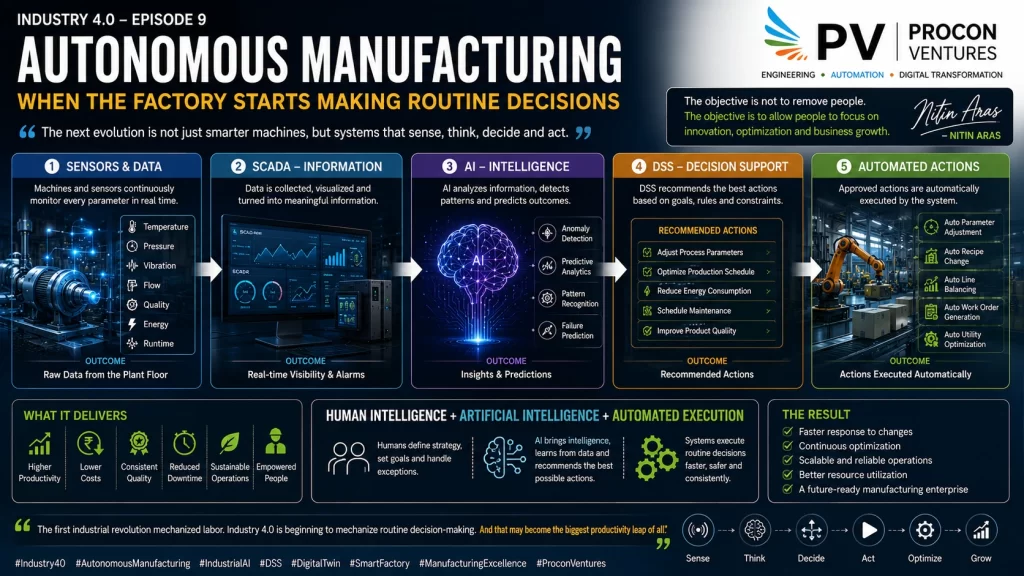
SCADA converts data into information.
AI converts information into intelligence.
DSS recommends corrective actions.
The next step?
Automatic execution.
How Autonomous Manufacturing Works
If steam consumption exceeds limits,
the system adjusts process parameters.
If product moisture drifts beyond tolerance,
the system corrects operating conditions.
If a machine shows signs of failure,
maintenance work orders are automatically generated.
If production demand changes,
line scheduling can be automatically optimized.
The New Operational Model
Humans remain responsible for strategy.
Machines handle routine execution.
This creates a new operational model:
Human Intelligence + Artificial Intelligence + Automated Execution
The Objective Is Not to Remove People
The objective is not to remove people.
The objective is to allow people to focus on innovation, optimization, and business growth instead of repetitive operational decisions.
Final Thought
The first industrial revolution mechanized labor.
Industry 4.0 is beginning to mechanize routine decision-making.
And that may become the biggest productivity leap of all.